Mikhail Tukhachevsky Air Land Battle Doctrine by Atenas Editores Asociados
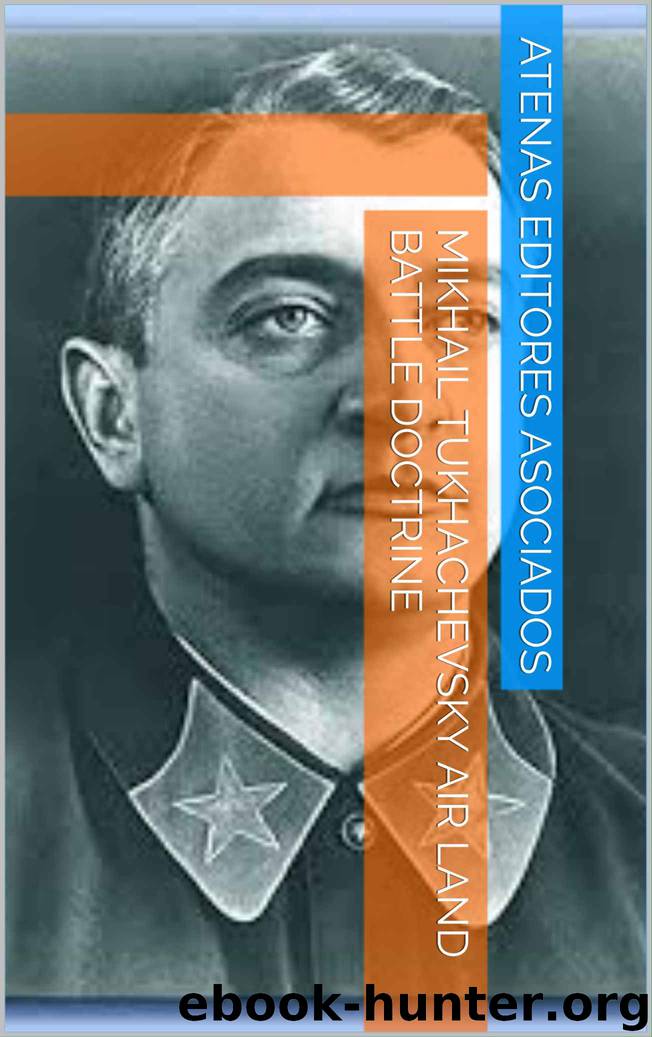
Author:Atenas Editores Asociados
Language: eng
Format: azw3
Published: 2016-05-30T16:00:00+00:00
Deep Operations during World War II
The abandonment of deep operations had a huge impact on Soviet military capability. Entering the Second World War after the German invasion of the Soviet Union in June 1941, the Soviets struggled to relearn it. The surprise German invasion (Operation Barbarossa) subjected the Red Army to six months of disasters. The Red Army was shattered during the first two months. Thereafter it faced the task of surviving, then reviving and maturing into an instrument that could compete with the Wehrmacht and achieve victory.
Soviet military analysts and historians divide the war into three periods. The Red Army was primarily on the strategic defensive during the first period of war (22 June 1941–19 November 1942). By late 1942 the Soviets had recovered sufficiently to put their concept into practice. The second period of war (19 November 1942 – 31 December 1943), which commenced with the Soviet strategic counteroffensive at Stalingrad, was a transitional period marked by alternating attempts by both sides to secure strategic advantage. After that deep battle was used to devastating effect, allowing the Red Army to destroy hundreds of Axis divisions. After the Battle of Kursk the Soviets had firmly secured the strategic initiative and advanced beyond the Dnepr River. The Red Army maintained the strategic initiative during the third and final period of war (1944–1945) and ultimately played a vital role in the Allied victory.
Download
This site does not store any files on its server. We only index and link to content provided by other sites. Please contact the content providers to delete copyright contents if any and email us, we'll remove relevant links or contents immediately.
| Africa | Americas |
| Arctic & Antarctica | Asia |
| Australia & Oceania | Europe |
| Middle East | Russia |
| United States | World |
| Ancient Civilizations | Military |
| Historical Study & Educational Resources |
The Radium Girls by Kate Moore(12120)
100 Deadly Skills by Clint Emerson(4984)
Rise and Kill First by Ronen Bergman(4859)
The Templars by Dan Jones(4751)
The Doomsday Machine by Daniel Ellsberg(4578)
The Rape of Nanking by Iris Chang(4277)
Killing England by Bill O'Reilly(4065)
Stalin by Stephen Kotkin(4025)
Hitler in Los Angeles by Steven J. Ross(3993)
12 Strong by Doug Stanton(3590)
Hitler's Monsters by Eric Kurlander(3412)
The Code Book by Simon Singh(3269)
Blood and Sand by Alex Von Tunzelmann(3259)
Darkest Hour by Anthony McCarten(3187)
The Art of War Visualized by Jessica Hagy(3058)
Hitler's Flying Saucers: A Guide to German Flying Discs of the Second World War by Stevens Henry(2785)
Babylon's Ark by Lawrence Anthony(2744)
Tobruk by Peter Fitzsimons(2575)
The Second World Wars by Victor Davis Hanson(2559)
